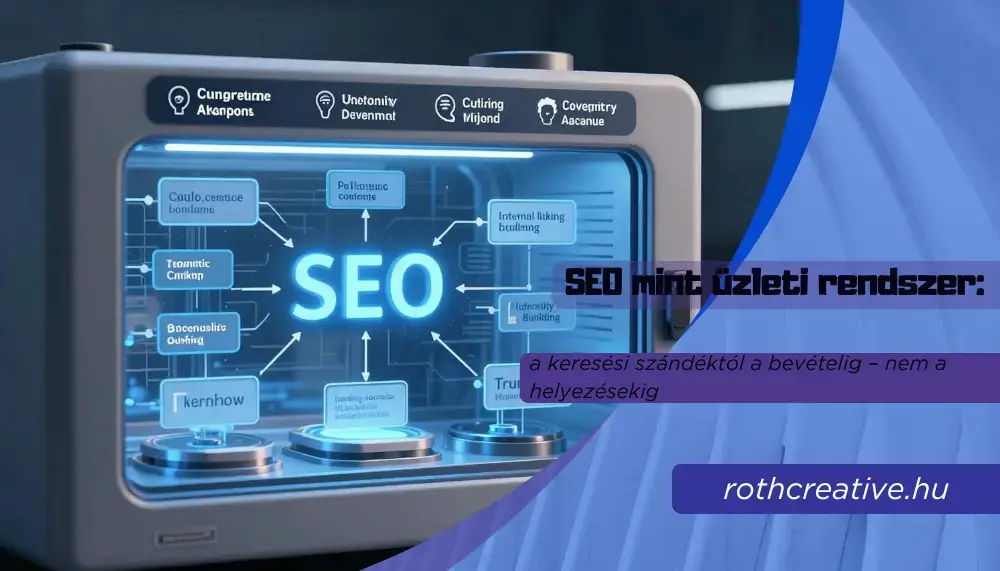
SEO as a Business System:
From Search Intent to Revenue,
Not Vanity Rankings
Many B2B executives evaluate Search Engine Optimization through a narrow, vanity-driven lens: keyword positions, impressions, and generic traffic peaks. The harsh truth is that rankings do not pay the payroll. A successful organic strategy treats SEO as a deterministic, end-to-end business system connecting technical infrastructure, semantic content architecture, network trust building, and high-conversion customer paths directly to pipeline value and recurring revenue.
Table of Contents
- Why Rankings Are an Intermediate Metric — The Vanity Trap
- Search Intent and Business Value: Mapping Commercial Intent to Margin
- Technical Foundation: The Hardware of Your Business System
- Content and Topical Authority: Creating Semantic Knowledge Graphs
- Authority Building: Reframing Link Building as Network Trust
- Revenue Measurement: The Interactive System Value Simulator
Why Rankings Are an Intermediate Metric — The Vanity Trap
In the boardrooms of modern enterprises, there is a recurring and costly misunderstanding: treating a high Google ranking for an arbitrary keyword as a success metric. An agency might present a report showing that your website ranks #1 for a term like “how does a business system work”. This looks impressive, but if your core business is selling enterprise-level supply chain software, that traffic is nothing more than expensive digital noise.
High-volume, low-intent keywords inflate your analytics dashboards, burn server resources, and dilute conversion metrics. True organic success is achieved when you focus on lower-volume, highly transactional queries — such as “B2B supply chain automation software pricing”. Position #4 for a commercial prompt can generate enterprise pipeline; position #1 for an informational, unrelated phrase often creates only a hollow vanity chart.
Rankings are merely an intermediate indicator. An effective search marketing agency does not sell positions; it builds systems designed to capture intent, establish trust, and drive high-intent users directly into your sales pipeline.
Search Intent and Business Value: Mapping Commercial Intent to Margin
Every search query represents a human trying to solve a specific problem. A sophisticated business system maps these queries to the correct commercial stages, ensuring that resources are spent on the keywords and prompts with the highest expected margin:
| Search Stage | Sample B2B Query | Business Value & Margin Potential |
|---|---|---|
| Informational | “What is cloud migration latency?” | Low direct margin. Captures early awareness, but requires complex nurturing. |
| Investigational | “AWS vs Azure latency comparison” | Medium-high margin. The buyer is evaluating options; perfect for deep case studies. |
| Transactional | “Enterprise cloud migration consulting service cost” | Maximum margin. The prospect is ready to purchase; requires high-trust landing pages. |
A resilient system does not treat all traffic equally. By allocating budget and content resources in a balanced portfolio — capturing transactional intent for immediate pipeline and investigational clusters to out-educate competitors — you create an organic customer-acquisition engine that compounds over time.
Technical Foundation: The Hardware of Your Business System
Technical SEO is not a one-time maintenance task; it is the hardware on which your marketing software runs. If your website is slow, affected by rendering issues, or configured with broken internal link structures, your content becomes practically invisible to search engine crawlers and emerging AI search agents.
A robust technical system focuses on two critical realities: crawlability and retrieval readiness. Search engines must be able to discover your pages with minimal resource expenditure — crawl budget optimization — and modern large language models must be able to parse, contextually index, and retrieve your data instantly through clean JSON-LD Schema structures.
Content and Topical Authority: Creating Semantic Knowledge Graphs
A common error in B2B marketing is the mindless publishing of generic blog posts. The “we need 10 posts a month” model creates fragmented, disconnected URLs that fail to rank and fail to build trust. In the AI era, search engines use semantic matching to evaluate your overall topical authority on a subject.
Your content must be designed as a semantic knowledge graph — topic clusters. This means building deep, authoritative pillar pages supported by highly specific, interlinked subpages addressing every related user query. This structure proves to both search algorithms and human buyers that you possess deep, comprehensive expertise in your field — not just shallow marketing copy.
Authority Building: Reframing Link Building as Network Trust
Traditional “link building” is often treated as a transactional, low-quality numbers game: purchasing spammy directory links to artificially inflate domain metrics. Modern search algorithms, powered by helpful content updates and entity tracking, can easily identify and neutralize these networks.
An advanced business system reframes link building as network trust and Digital PR. A link is a third-party citation — a vote of confidence from another trusted entity in your space. We build authority by placing your data, original research, and expert insights on high-authority industry publications, creating a web of independent corroboration that tells Google and large language models that your brand is a trustworthy authority.
Revenue Measurement: The Interactive System Value Simulator
To truly manage SEO as a business system, organic traffic must be connected directly to pipeline and revenue metrics. Use the interactive simulator below to estimate the potential revenue contribution of your organic funnel:
📈 System Value & ROI Simulator
Estimated Monthly Pipeline Value
By connecting your search-intent portfolio, structural site health, and authoritative network trust building directly to bottom-line performance, SEO is no longer a speculative marketing expense — it becomes a predictable, compounding financial asset.
Ők már minket választottak:
- https://rothcreative.hu/keresooptimalizalas/
- 1. https://fenyobutor24.hu/sct/566800/BUTOROK
- 3. https://karpittisztitas.org
- 3. https://aimarketingugynokseg.hu/premium-linkepites-pbn
- 5. https://kisautok.hu/warhammer
- 6. https://respectfight.hu/kuzdosport-felszerelesek/kesztyuk/boxkesztyuk-mubor
- 7. https://aimarketingugynokseg.hu/keresooptimalizalas-google-elso-hely
- 8. https://zirkonkrone240eur.at/lumineers
- 9. https://onlinebor.hu
- 10. https://aimarketingugynokseg.hu/google-ads-seo-kulonbseg/
- 10. https://www.prooktatas.hu/python-tanfolyam
- Seo ügynökség https://aimarketingugynokseg.hu/
- 14. https://szeptest.com/mellplasztika
- 15. https://www.gutta.hu/eloteto
- 16. https://aimarketingugynokseg.hu/keresomarketing-ugynoksegek
A Roth Creative nemcsak egy újabb marketing ügynökség – mi vagyunk a kulcs, amire vállalkozásodnak szüksége van az internetes sikerhez. Akár a Google találati listájának élére szeretnél kerülni keresőoptimalizálásunkkal, akár kreatív hirdetési kampányokkal keresel több ügyfelet, nálunk minden eszközt megtalálsz. Célunk, hogy ne csak jelen legyél online, hanem hogy valódi eredményeket érj el!
Comments are closed