AI Strategy · Executive Decision-Making
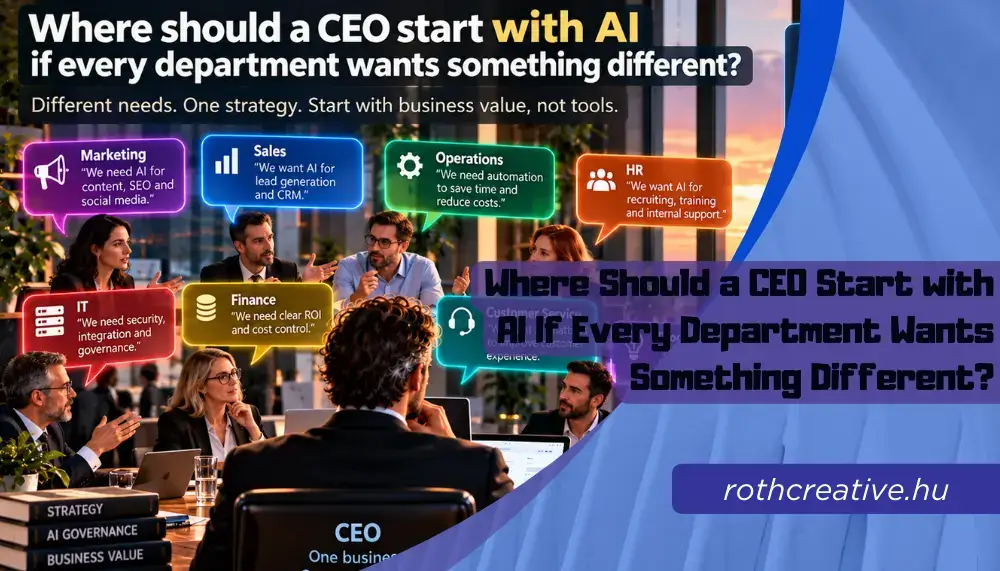
Marketing wants a content factory, sales wants call analysis, HR wants CV screening, finance wants automated invoice processing, customer service wants a chatbot – and every department is convinced that its request is the most urgent. A good CEO does not decide who is right. A good CEO prioritizes. Here are the five factors that turn the “who shouts the loudest” debate into a measurable, defensible decision.
The Article in 30 Seconds
Do not decide based on the loudest department or the most impressive demo. Evaluate every candidate use case using the same five factors: business pain, feasibility, data maturity, risk and the speed of measurable feedback.
The first project should be narrow and valuable: one process, one owner, one metric, 6–12 weeks. You are not building a platform – you are building decision-making capability, and the first project is its prototype.
01 — The StakesWhy Is the First AI Project Such an Important Decision?
The first AI project rarely remains just the first AI project. It sets the organization’s expectation level, determines the approximate budget for the following year, and shapes whether the leadership team treats AI as an investment or as a cost. That is why a poorly chosen first project costs far more than the money spent on it.
It damages three things at the same time:
- The organization’s belief. After a spectacular and expensive failure, you may not get budget for the second project – even if that second project would actually be good.
- The data infrastructure. If the first project is built on poor data, every later project is built on the same weak foundation.
- Trust in the technology. “We already tried it; it doesn’t work” is the most expensive sentence an organization can learn.
The opposite extreme is not better either. The strategy of “let’s wait until the technology matures” is not risk avoidance but an invisible form of accepting risk: your competitor is meanwhile learning which processes AI works in and which ones it does not – and that knowledge cannot be downloaded; it can only be acquired.
“I rank candidate use cases using five criteria: business pain, feasibility, data maturity, risk and the speed of measurable feedback. The first project should solve a narrow but valuable problem – it should not be selected because a vendor has an impressive demo.”
02 — DiagnosisFive Bad Reasons Why Most Companies Choose the Wrong Project
Before ranking anything, it is worth looking honestly at how the current candidate list was created. The patterns below appear in almost every organization – and each produces predictable failure.
1. “The Vendor’s Demo Was Impressive”
The demo was built on their data and for their scenario. The quality of the demo tells you about the vendor’s marketing budget, not your processes. A useful question is: “Show me the same thing with three of our real documents, right now.”
2. “Our Competitor Is Doing It Too”
Your competitor has a different market position, different data and different process design. The most expensive thing about copying is that it looks like you have a strategy – while you do not.
3. “Whichever Department Shouts the Loudest”
Prioritization becomes political, and the organization quickly learns that value does not matter – volume does. Over time, this makes your best people passive.
4. “Let’s Build a Large AI Platform”
Nine to eighteen months, significant cost, no business result at the end – and halfway through the project you discover that the data issues had to be solved anyway. Build the platform after the third successful project, not instead of the first one.
5. “Let’s Buy Everyone a License and See What Happens”
That is not a strategy; it is a cost. More dangerous, however, is shadow AI: teams begin using tools on their own, without an approved framework, often with sensitive data. A ban is not the solution either – it only pushes usage underground.
03 — The FrameworkThe Five Factors That Make the Chaos Rankable
The point of the framework is not the scoring itself – it is that you ask the same question about every candidate. That is what turns a “this is what I think” debate into a measurable conversation. Score every factor from 1 to 5, then weight it as follows.
What measurable loss in money, time, quality or risk does the problem cause today? Not “it would be nice,” but “this hurts.”
Key question: “If I solved this tomorrow, which number would change in the monthly report?”
Are the input and output clear? Is there a meaningful precedent? Is the task generation, classification or decision-making? The more structured it is, the higher the score.
Key question: “Could I describe the task so clearly that a new employee could perform it?”
Where is the data? Can it be accessed? Is it clean, consistent and up to date? Can it legally be used? This is the factor that kills most projects.
Key question: “How many days would it take to collect and make the data usable – not to implement the tool?”
What happens if it is wrong? Who gets harmed? Can the decision be reversed? Is there human approval? The lower the cost of error, the higher the score.
Key question: “How much money, time and reputation does one bad AI decision cost?”
Will there be a measurable result within 90 days? On a metric that finance also recognizes? Fast feedback makes learning and continuation possible.
Key question: “Exactly which number will we look at on day 90, and who decides whether it worked?”
Above 70 points: proceed. 55–70: narrow the scope and reassess. Below 55: backlog; review it again in six months.
The calculation itself does not make the decision – but disagreement behind the scores is often the most valuable information.
| Factor | Weight | 1 Point (Weak) | 5 Points (Strong) |
|---|---|---|---|
| Business Pain | 25% | Convenience issue, no measurable impact | Several million HUF per year or hundreds of working hours |
| Feasibility | 20% | Open-ended, difficult-to-define task | Structured, clearly describable, repetitive task |
| Data Maturity | 20% | Data exists on paper or in people’s heads | Structured, accessible, clean and legally usable |
| Risk (inverse) | 15% | Affects customers or legal relationships and cannot be reversed | Internal process, human approval, reversible |
| Speed of Feedback | 20% | Impact becomes visible only after 12 months | Measurable within 4–8 weeks using a business metric |
Do not fill out the table together the first time. Send it to the leadership team and have everyone score the candidates independently, then compare the results afterwards. Where the scores differ widely, there is no shared view of the facts – and that should be clarified before making any decision about tools. Where the scores are close, you can decide quickly.
04 — Department MapWhat Each Department Wants – and What You Should Actually Build First
The list below is not a universal truth but a typical pattern. The important distinction is between what the department requests and the smallest version that addresses the same pain but can be measured safely and quickly.
05 — The ScopeWhat Does “Narrow but Valuable” Actually Mean?
“Narrow” does not mean insignificant. It means the number of variables is controlled. In the first project, every expansion introduces another potential failure point that you do not yet know how to diagnose.
- One process. Not “sales,” but “the first response to incoming quote requests.”
- One owner. One business owner whose KPI changes because of the project. If there are two owners, there is no owner.
- One metric. One number that you already measure today – not a new metric invented for the project.
- One team. 5–15 people who use it every day. “Eventually everyone” never happens.
- 6–12 weeks. If it takes longer, split it up. If it takes less time, it is probably not valuable enough.
- There is a rollback point. You can return to the previous process at any time without consequences.
Bad goal: “Implement AI-based customer service.”
Good goal: “Automatically generate suggested replies to return-related emails
for the three most common cases, for the Budapest team’s 6 service representatives, measuring
response time and average handling time, within 8 weeks.”
The pain is the same, but the latter can be completed. In the first project, finishability is more important than ambition.
06 — The RoadmapThe 30–60–90 Day Plan
Discovery and Prioritization
Collect every candidate use case – preferably in writing from department heads. Score them separately using the five factors, then compare the differences in a joint meeting. In parallel, create a one-page AI policy: what data may be entered, what may not, and who approves.
Output: ranked list + selected first projectNarrow Pilot, Starting Without Live Production Exposure
Do not think in terms of full deployment: use a small group, real data and a real workflow, but inside a controlled environment. The pilot’s purpose is not savings but learning – so measure the failures as well as the successes.
Output: measurable result + documented lessonsDecision and Institutionalization
There are three possible outcomes, and all three are results: scale (there is proven impact), narrow or restart (it may work with a different scope), or stop (you learned cheaply that it does not work). By day 90, there should be a next project and a person responsible for AI.
Output: decision, budget, owner, second project07 — GovernanceWho Decides, What Is the Budget, and What Are the Rules?
Most AI projects do not fail because of the technology, but because nobody knows who owns the decision. Three things must be clarified before anything is launched.
Who Is Responsible?
AI cannot be delegated as a side task to a “digitalization employee.” You need a business owner who understands the pain and a technical owner who leads implementation – but the prioritization decision remains with the leadership team. If the CEO does not pay attention to it, the organization interprets that as a signal that it is not important.
What Is the Budget?
Do not treat the first project as an investment project, but as a learning budget. Set an upper threshold below which no additional approval is required. This enables fast experimentation without every step ending up on your desk.
What Are the Rules?
A one-page policy is worth more than a thirty-page document that nobody reads. It should answer three questions: what data may be entered into an AI tool, what requires human approval, and what must be documented. Shadow AI should not be banned; it should be given a framework – otherwise it continues after the ban, only you no longer see it.
The EU AI Act (Regulation 2024/1689/EC) is entering into force gradually. Obligations concerning prohibited practices and AI literacy have applied since February 2, 2025, rules relating to general-purpose AI models since August 2, 2025, and transparency obligations since August 2, 2026. The deadline for requirements relating to high-risk systems, such as recruitment screening, was modified by the 2026 digital omnibus – therefore, exact dates should be checked with a lawyer before entering such an area.
Practical consequence: do not make a high-risk area your first project. With simple, internal projects that include human approval, regulatory risk also remains at a manageable level.
08 — Warning SignsFive Traps Most First Projects Fall Into
- The pilot has no owner. “We are doing it together” means nobody is responsible. If there is no single name next to the project, stop it and start again.
- You automate a bad process. AI speeds up what you already do – including the bad parts. Simplify the process first, then automate it.
- You ban shadow AI instead of creating a framework. People will still use it; they simply will not tell you. Give them rules and tools, not just a ban.
- You build everything around one vendor. During the first project, examine at least two approaches – not because you need to switch later, but because you need to understand what you chose.
- You imagine AI implementation without organizational change. If the process, ownership and metric do not change, introducing the tool becomes only a cost.
09 — Frequently Asked QuestionsWhat CEOs Ask Most Often
Do We Need a Separate AI Team or AI Leader to Get Started?
Not for the first project. What you need is a business owner, a technical implementer and a clear decision framework. It makes sense to appoint an AI leader once you already have at least two or three active or completed projects and coordination has genuinely become a bottleneck. Earlier, it is an unnecessary position; later, it becomes essential.
How Quickly Should I See Results from the First Project?
Ninety days is a realistic limit. Within the first 4–6 weeks, you should already see operational signals – whether people use it and whether quality improves – and by day 90 there should be a measurable result on a business metric. If that is technically impossible for a candidate use case, it is not suitable as a first project, however valuable it may be in the long term.
What Should the First Project Be If Our Data Is Not in Good Shape?
Choose a project that improves the data while it runs. The best first projects often structure the data as a side effect: summarizing customer conversations in a CRM-ready form, extracting data from incoming documents, or mapping the internal knowledge base. This way, the data project is not a separate cost center but part of the first success.
Should We Build Our Own Model or Buy an Existing Solution?
For the first project, almost always buy or use an existing tool. Building your own model pays off only when you have a unique dataset or process characteristic that others cannot reproduce – and you can usually prove that around the third project, not the first one.
How Should I Handle a Department Head Who Insists on Their Own Project?
Take the discussion back to the table. Have that person score the project using the same five factors, then compare the score with everyone else’s. If their project is genuinely strong, the numbers will show it – and then they win. If not, the discussion is about facts, not personalities. That is the greatest benefit of the framework: prioritization moves from a political debate to a professional one.
What Happens If the First Project Fails?
It counts as failure if you cannot explain why it did not work. If you documented the assumptions, measured results and decision points, then even a stopped project produces information. The most important message to the organization is: learning is not punished; silence is. What you say on day 90 will shape the organization’s AI maturity for the next two years.
10 — SummaryThe Most Important Decision Is Not the Tool, but the Framework
If it had to be summarized in one sentence: the objective of the first AI project is not to prove that AI works, but to teach your organization how to make decisions about AI.
Technology keeps changing, models are replaced and tools become cheaper. What remains is the decision framework: the five factors, shared scoring, narrow scope, the 90-day cycle and documented lessons. An organization that builds this can make good decisions within weeks by the third project. One that does not may still be having the same debate five years from now, only about more expensive tools.
So the task is not to select the perfect first project. It is to build a decision process that selects it – and one that your leadership team considers its own because they participated in the scoring.
Would You Like Your First AI Project to Be a Decision, Not an Experiment?
We help you apply the five-factor prioritization framework to your own processes and identify the narrow, quickly measurable area where the investment can be traced within 90 days – across SEO, content, web development and AI-based automation.
Request a Free Consultation
Comments are closed