Tartalomjegyzék
Toggle
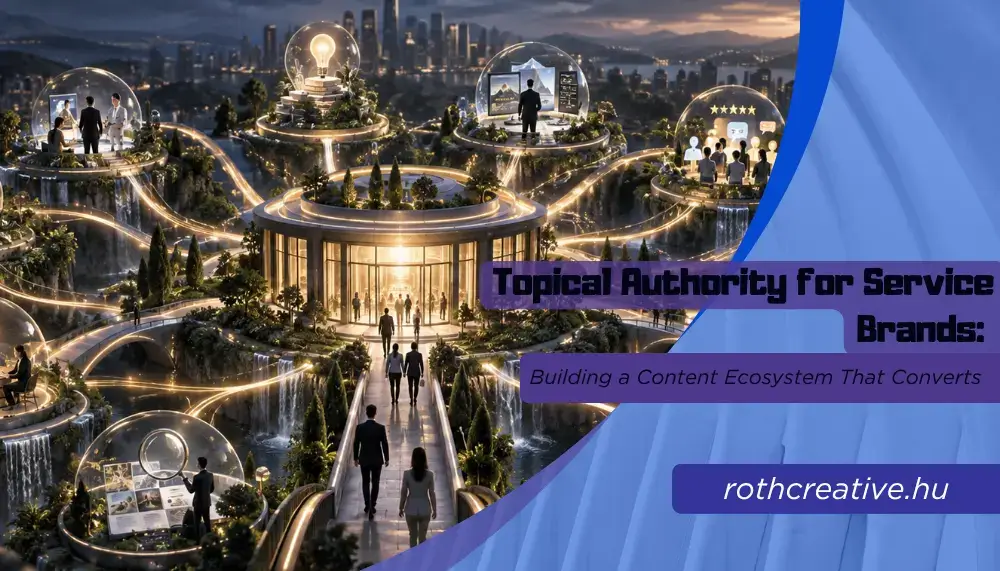
Topical Authority for Service Brands:
Building a Content Ecosystem
That Converts
One of the biggest organic-search mistakes made by B2B service brands and professional consulting firms is treating content marketing as the production of isolated, ad hoc blog posts. In the modern search environment, keyword optimization alone is no longer enough: Google and AI systems increasingly interpret thematic expertise (Topical Authority) and consistent semantic networks. This guide explains how to build a conversion-focused content ecosystem designed to turn visitors into qualified leads and pipeline value in a more predictable way.
Table of Contents
- From Blog Posts to Ecosystems – The Semantic Transition
- Pillar-Service Relationship – Connecting Service Pages and Pillars
- Cluster Design – Precise Topic-Cluster Architecture and Content Types
- Internal Links – S-I-C-T Cohesion Transfer Through the Site Architecture
- Expert Proof – Building Evidence and Credibility (E-E-A-T)
- Conversion Paths – Turning Topical Trust into Revenue
- Interactive Topical Authority & Cluster Builder Software
From Blog Posts to Ecosystems – The Semantic Transition
For decades, traditional content marketing followed an extremely superficial, linear logic: identify several high-search-volume keywords, write a standalone blog post for each one, and hope that organic Google traffic would eventually generate conversions. By 2027, this model has become insufficient as a complete strategy.
Businesses competing online can no longer rely on isolated pieces of content. Instead, they need to build a semantic knowledge network — a Content Ecosystem on their website that demonstrates the depth and consistency of their expertise across an entire subject area.
Building Topical Authority means that your website does not merely mention a subject. It addresses the relevant customer questions, problems, comparisons and alternatives in depth and in a structured, interconnected way.
Pillar-Service Relationship – Connecting Service Pages and Pillars
For service businesses, the primary business value is usually concentrated on service pages. These are your transactional nodes: this is where visitors request proposals, make phone calls or book consultations. However, service pages alone often struggle to rank for highly competitive informational searches because they usually contain less educational and explanatory content.
The solution is to build a strong Pillar-Service Relationship. The central service page — for example, “Enterprise Cloud Consulting” — should be directly connected to a comprehensive, in-depth Pillar Page that explains the entire subject area conceptually and structurally. The pillar page can attract broader, early-stage informational traffic, which can then be guided through internal links toward the transactional service page.
Cluster Design – Precise Topic-Cluster Architecture and Content Types
The pillar page is the heart of your knowledge hub. It should be surrounded by tightly related and highly specific topic clusters — Sub-pages / Cluster Articles. A well-designed cluster should include the following content types according to buyer intent:
- Informational Clusters: In-depth technical or theoretical guides explaining important industry concepts.
- Investigational / Comparison Clusters: “X vs Y” analyses, decision checklists and advantages-versus-disadvantages matrices.
- AEO Answer Nodes: Concise definitions and FAQ blocks structured so that generative answer engines such as Perplexity can easily understand and retrieve the information.
During cluster planning, each subpage should answer one clearly defined, distinct customer question as precisely as possible, while avoiding unnecessary internal keyword cannibalization.
Internal Links – S-I-C-T Cohesion Transfer Through the Site Architecture
Your internal linking network is the circulatory system of your website. It helps distribute PageRank and contextual relevance between individual pages. The third layer of the S-I-C-T framework used by Roth Creative — Cohesion — focuses on precisely this internal relationship structure:
- Every cluster subpage should link back to the central Pillar Page and relevant Service Page — upward links.
- The Pillar Page should logically reference the detailed cluster subpages — downward links.
- Where editorially relevant, cluster pages should also link to one another within the topic — lateral links — creating a coherent semantic silo.
- Anchor text should accurately and descriptively reflect the content of the destination page.
Expert Proof – Building Evidence and Credibility (E-E-A-T)
Service brands do not sell physical products — they sell trust and professional expertise. Within Google’s E-E-A-T framing — Experience, Expertise, Authoritativeness and Trustworthiness — content credibility can be strengthened through real professional evidence and transparent authorship.
Professional articles should be connected to clearly identifiable, real human experts with author profiles and supporting professional information where appropriate. Claims can be strengthened with proprietary case studies, real client statistics, original research data and reputable external industry references.
Conversion Paths – Turning Topical Trust into Revenue
Even strong Topical Authority creates little business value if incoming visitors leave the website without converting. Every informational cluster page should therefore contain a clear Conversion Path aligned with the visitor’s current stage of the decision-making journey:
- Early-Stage Visitor — Awareness: A free, high-value professional template, checklist or e-book — lead magnet — can provide an appropriate next step.
- Mid-Stage Visitor — Evaluation: An interactive ROI calculator or detailed case study can help move the visitor toward a commercial decision.
- Decision-Stage Visitor: A direct and prominent Call-To-Action — CTA — should make it easy to request a proposal or book a consultation.
When tracking business return — ROI — it is important to recognize that last-click attribution models can undervalue organic channels, particularly when users research through generative search systems. Measurement should therefore also account for relevant assisted conversions.
Interactive Topical Authority & Cluster Builder Software
Select the architectural elements you have already implemented around your priority service. The system will calculate an indicative Topical Authority architecture score based on the eight elements below:
🕸️ Enterprise Topic Cluster & Authority Builder
Would you like to transform your entire service portfolio into one coherent, conversion-focused semantic ecosystem?
Avoid fragmented content production. Let us design and implement a comprehensive Topical Authority network around your business that creates clear value for both humans and machine-readable systems.
Request Semantic Architecture for My Service Portfolio →Ők már minket választottak:
- https://rothcreative.hu/keresooptimalizalas/
- 1. https://fenyobutor24.hu/sct/566800/BUTOROK
- 3. https://karpittisztitas.org
- 3. https://aimarketingugynokseg.hu/premium-linkepites-pbn
- 5. https://kisautok.hu/warhammer
- 6. https://respectfight.hu/kuzdosport-felszerelesek/kesztyuk/boxkesztyuk-mubor
- 7. https://aimarketingugynokseg.hu/keresooptimalizalas-google-elso-hely
- 8. https://zirkonkrone240eur.at/lumineers
- 9. https://onlinebor.hu
- 10. https://aimarketingugynokseg.hu/google-ads-seo-kulonbseg/
- 10. https://www.prooktatas.hu/python-tanfolyam
- Seo ügynökség https://aimarketingugynokseg.hu/
- 14. https://szeptest.com/mellplasztika
- 15. https://www.gutta.hu/eloteto
- 16. https://aimarketingugynokseg.hu/keresomarketing-ugynoksegek
A Roth Creative nemcsak egy újabb marketing ügynökség – mi vagyunk a kulcs, amire vállalkozásodnak szüksége van az internetes sikerhez. Akár a Google találati listájának élére szeretnél kerülni keresőoptimalizálásunkkal, akár kreatív hirdetési kampányokkal keresel több ügyfelet, nálunk minden eszközt megtalálsz. Célunk, hogy ne csak jelen legyél online, hanem hogy valódi eredményeket érj el!
Comments are closed