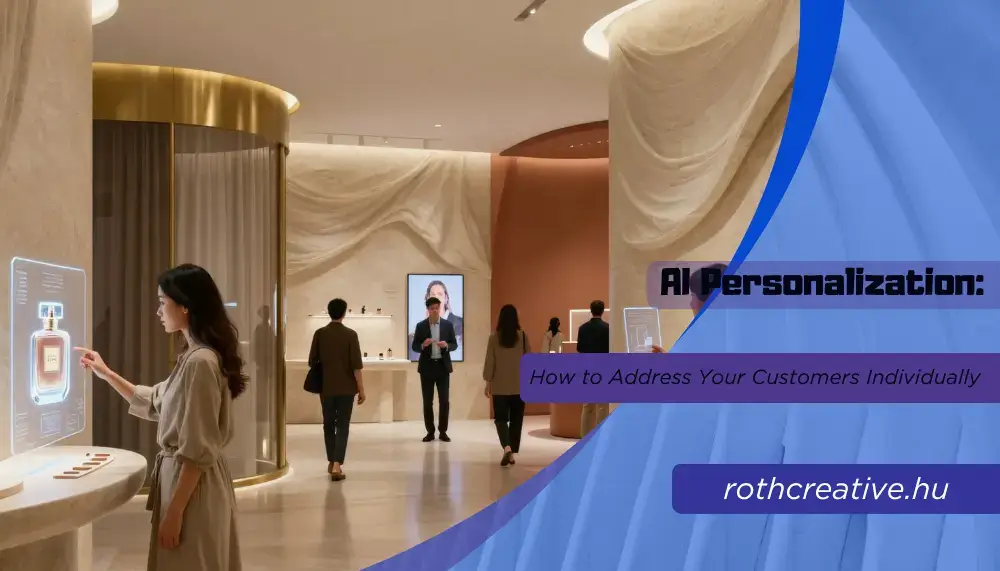
Your customers’ attention is being courted by thousands of messages every day. Banners, newsletters, push notifications, ads—a sea of noise. Only one thing can make your brand stand out: if your message arrives as if it were crafted exclusively for that one person.
In the past, this required a brilliant copywriter and a very patient team. Today, AI personalization performs this work automatically across thousands of customers simultaneously—and you don’t have to be a data scientist to use it. In this article, we’ll walk through how it works in practice across email, websites, product recommendations, and advertising.
What is AI Personalization — Honestly, for Beginners
Let’s forget terms like “machine learning” and “predictive engine” for a moment. The essence of AI personalization fits into a single sentence: AI decides what, when, and how to show something to a specific person—instead of sending the same thing to everyone.
To do this, it needs three things: data (who the customer is, what they’ve done so far), pattern recognition (what people similar to them respond to), and a decision point (should we send an email now? what offer should we show on the homepage?). These three steps used to be handled by marketers; now, AI performs them ten billion times faster.
The most important thing to understand as a beginner: AI personalization isn’t magic; it’s a combination. Data + Rules + Learning. If any of these are weak, the result will be weak as well.
The Email That Was Truly Written for You
Email is the channel where most companies first encounter the power of AI personalization. This is no coincidence: feedback is fast, the entry barrier is low, and every move (opens, clicks, purchases) is easily measurable.
Where does the AI step in? In a modern email platform, AI doesn’t just intervene in one place, but almost everywhere—though it’s not always visible to the user. Typical points include:
- Subject line generation and A/B testing: The AI writes multiple subject line variations, sends them to a sample group, sees which one gets more opens, and then sends the winner to the rest.
- Send-time optimization: You don’t send to everyone at 10:00 AM; instead, everyone receives it at their own usual reading time.
- Content block swapping: The “featured product” section of the same newsletter is different for every customer—tailored to what that specific person was browsing on the site.
- Inactivity detection: If someone hasn’t opened your emails for three weeks, the AI stops sending sales messages and starts a re-activation sequence instead.
What this means in practice At a webshop where we introduced behavior-based segmentation, email open rates didn’t rise because we wrote “better copy.” It was because every customer received the email on the day, at the hour, and with the product recommendation that fit their pattern. The same newsletter—in thousands of unique versions.
When the Website Recognizes You
Imagine two people opening your website at the same time. One arrives from a Google search for “running shoe price.” The other comes from a LinkedIn article discussing your B2B services. Should we show them the same homepage? Common sense says: no.
Dynamic, AI-based website content solves exactly this. It’s the same URL, but the header text, hero image, featured products, and even the offers change depending on who is looking.
What can be dynamically personalized?
- Headline and hero text: Different main messages based on the traffic source (Google, Facebook, LinkedIn, newsletter).
- Featured categories: Returning visitors see the categories they previously browsed at the top.
- Geographic-based offers: A visitor from Budapest won’t see the Debrecen pickup point first.
- CTA button text: We don’t immediately show “Buy Now” to a “first-time visitor”; we show “Learn More.”
- Pop-up timing: AI decides who should see a subscription pop-up and who shouldn’t (because they’ve already subscribed or are just about to make a purchase).
A good dynamic website isn’t obvious. The customer doesn’t feel like they’re seeing a different version—they just feel that “this company somehow understands me.”
The Secret Sauce of “You Might Also Like”
Product recommendation systems most vividly demonstrate why AI personalization can bring double-digit percentage increases in revenue. A significant portion of Amazon’s and Netflix’s traffic comes from recommendations—but this logic can now be implemented even in a medium-sized local webshop.
Three types of recommendations you should know:
- Content-based recommendation: “These products are similar to what you’re looking at.” Good when you don’t know much about the customer yet but know the product.
- Collaborative filtering: “People who bought this also bought that.” This works when you have a lot of data on other customers’ behavior.
- Hybrid, AI-based models: These combine the two and take into account time, seasonality, inventory, and even price sensitivity.
Pro Tip: Product recommendations aren’t just for product pages. The best places to deploy them: the cart page (“anything else?”), the thank-you page after purchase (“you might be interested in these next time”), the weekly block of a newsletter, and the 404 error page—which is an absolute goldmine if used cleverly.
Ads That Aren’t Intrusive
Personalized ads have a bad reputation for anyone who has ever been “chased” for three weeks by a shoe they accidentally clicked on. The problem isn’t personalization—it’s that it was done poorly. Well-deployed AI-based advertising isn’t intrusive; it’s timely. It doesn’t repeat; it evolves. It doesn’t harass; it recognizes when someone dropped out of the buying process and what they were missing.
What does AI do in advertising platforms today?
- Lookalike targeting: The AI looks at your best existing customers and finds people who are similar to them in behavior.
- Dynamic Creative Optimization (DCO): The ad’s image, text, and button combine automatically based on which combination brings the best results for a given audience.
- Budget allocation: AI doesn’t distribute the budget equally among your ads; it pushes it where the return is currently best.
- Frequency control: If someone has already bought what they were looking at, the AI moves them to a different message—it doesn’t keep showing them the same thing.
The key is one word: relevance. Good personalization makes the customer feel like you’re making their day a bit easier—not like you’re lurking over their shoulder.
How to Get Started as a Beginner: Step by Step
AI personalization often feels daunting to beginners because people try to sell you email, website, recommendation, and advertising solutions all at once. You don’t need everything at once. In fact, you shouldn’t.
- Clean up your data: Before buying any AI tool, see if you know who’s who among your customers. A decent CRM or email system is a goldmine in itself.
- Choose one channel: For most companies, email is the best entry point. It’s fast, measurable, and any mistakes can be fixed at a low cost.
- Start with simple segmentation: New subscriber, active buyer, inactive contact. These three basic segments are already more than what most companies use. AI can build upon these.
- Test every step: Don’t just believe what a tool promises. Set up a control group and see numerically what personalization brought in. AI can be wrong too.
- Scale if it works: Only build a new layer once one channel is working—product recommendations in the webshop, dynamic content on the homepage, AI-based ad optimization. Never the other way around.
The best AI personalization projects don’t start with “let’s buy an AI tool.” They start with “let’s understand exactly why our customers aren’t clicking.”
FAQ
What is AI personalization simply, for beginners?
AI personalization means that your marketing messages (email, website content, product recommendations, ads) automatically adjust to who is viewing them. Artificial intelligence looks for patterns in behavior, interests, and purchase history, and based on these, decides what, when, and how to show to that specific person.
How much data do I need to start?
Much less than you think. Even a few pieces of basic information—such as traffic source, browsing history on your site, or a previous purchase—are enough to create meaningful segments. While training large models requires a lot of data, for everyday marketing personalization, most modern tools work even with a small customer base.
Doesn’t it feel awkward if we know too much about the customer?
The line between helpful and creepy personalization is whether the message provides value to the customer or just exerts pressure. If personalization makes a decision easier, brings a relevant offer, or saves time, it’s a positive experience. However, if it emphasizes something the customer hasn’t even said they’re interested in, it’s a warning sign.
Which channel is worth starting with?
For most companies, email is the best entry point. This is where feedback is fastest, the technological barrier is lowest, and every step is easily measurable.
How much does it cost to start an AI personalization project?
The cost varies greatly—a small business can get a lot out of a newsletter system costing a few tens of thousands of forints per month with simple automated segments. A complex, multi-channel personalization (email + website + product recommendations + ads) is a strategic investment. The good news: you don’t have to introduce everything at once.
Want your customers to feel like you’re speaking only to them? At CRS AI Marketing & SEO Agency, we build exactly that: AI-based personalization systems that aren’t just slogans but bring measurable results. Let’s look together at where your biggest focus starts.
Légy Te is része ügyfeleink sikereinek!
- https://rothcreative.hu/keresooptimalizalas/
- https://lampone.hu/eloteto
- https://aimarketingugynokseg.hu/
- https://respectfight.hu/kuzdosport-felszerelesek/kesztyuk/boxkesztyuk-mubor
- https://fenyobutor24.hu/sct/566800/BUTOROK
- https://onlinebor.hu
- https://karpittisztitas.org
- https://aimarketingugynokseg.hu/keresooptimalizalas-google-elso-hely
- https://www.gutta.hu/eloteto
- https://aimarketingugynokseg.hu/premium-linkepites-pbn
- https://zirkonkrone240eur.at/lumineers
- https://kisautok.hu/warhammer
- https://szeptest.com/mellplasztika
- https://aimarketingugynokseg.hu/google-ads-seo-kulonbseg/
A Roth Creative egy dinamikus online marketing ügynökség, amelynek célja, hogy vállalkozásod kiemelkedjen a digitális világ zajából. Tudásunkkal és kreativitásunkkal garantáljuk, hogy online jelenlétedet eredményessé és hosszú távon fenntarthatóvá tegyük. Olyan szolgáltatásokkal segítünk, mint a keresőoptimalizálás (SEO), a pay-per-click (PPC) hirdetési kampányok kezelése és a közösségi média marketing, hogy célközönségedet pontosan és hatékonyan érd el.
Comments are closed